Baggage Reclaim: Empowering advice for helping you offload your baggage & discover the great you that already exists. |
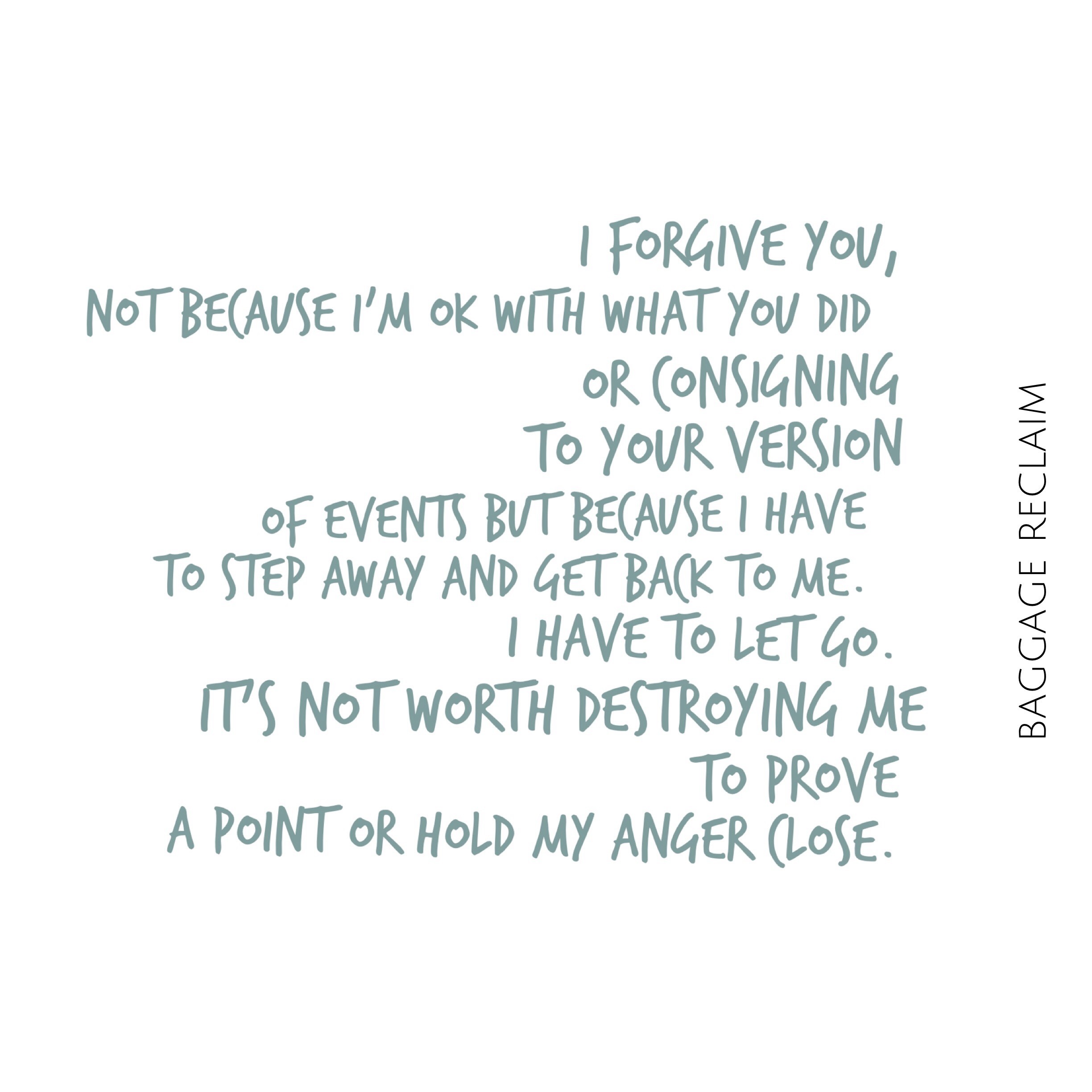
| Forgiveness isn’t about agreeing with or condoning the other person’s actions Posted: 06 Jan 2015 01:57 PM PST As I continue making peace with my past and recognising younger parts of me that still hurt and remember, not only am I committed to being self-compassionate and learning from when I’m not, but I’m also committed to not letting my past and those in it get away with robbing me of my present and my peace. I’m in command of me now and I can’t give away my chance at life and my journey because it didn’t start out as I would have liked and because of pain I’ve experienced. In the end, much as I could hold certain things front and centre in my heart and mind and even try to make, for instance, my parents ‘make up’ for everything, it’s me who will feel my commitment to the past and the pain the most. Forgiveness doesn’t mean that you’re saying that the other person is “right” or that what they did is/was “OK”; it’s about choosing and re-choosing to let go so that you don’t get stuck living in the past. You forgive, not to anoint the other party with something but to release you to move on and evolve beyond it. Big blocks around forgiveness are fear of condoning, fear that we’re giving them or the universe the blueprints to screw us over, fear of looking weak and fear of being vulnerable by putting ourselves out there again and putting ourselves back together. It’s like, What if I forgive and then I try again at life and get screwed over? What if they think that they’ve gotten away with it? As I continue making peace with my past and recognising younger parts of me that still hurt and remember, not only am I committed to being self-compassionate and learning from when I’m not, but I’m also committed to not letting my past and those in it get away with robbing me of my present and my peace. I’m in command of me now and I can’t give away my chance at life and my journey because it didn’t start out as I would have liked and because of pain I’ve experienced. In the end, much as I could hold certain things front and centre in my heart and mind and even try to make, for instance, my parents ‘make up’ for everything, it’s me who will feel my commitment to the past and the pain the most. It’s about getting into the present because when you’re actively or passively holding on, you’re not letting go. You might be trying to right the wrongs of the past in some way or ‘dining’ what may be every single day off the anger and other emotions. You may keep rubbing your face in where you feel that you’ve erred and/or rubbing your face in the other person’s behaviour while at the same time attributing it to you. You forgiving doesn’t mean, I’m right – they’re wrong. Or, I’m wrong – they’re right. It’s about deciding to be done. Part of our reluctance to let go and forgive is about our relationship with ourselves. Not the outer one that we project but the inner one driven by our thought and feelings ‘conversations’. It’s what goes on behind closed doors. Many of us are attached to the narrative, to the ‘reasoning habits’ (beliefs) and it can feel easier to keep telling the stories while berating us in the process or feeling almost righteous about how wrong the other person is, that we forget that we’re not fully occupying our actual lives and the story of our lives are continuing but are, until we decide to let go, becoming a story about us telling a story. If you’ve struggled with deciding to be done, where are you judging you in some way? Where are you reluctant to let go of the security blanket of the story and your position, where yes, you might feel righteous or consumed by the injustice of it all. Where are you reluctant to trust you and move on? Where might you be holding onto a ‘child role’ and avoiding responsibility? Something really pissed me off a few weeks back – blummin’ family smoking too much It’s December Crack – and it brought up some old stuff for me that caught me off guard. It’s important to note that we can fall into the trap of not acknowledging the usefulness of discovering that we can be triggered by something – these are actually opportunities to take the sting out of past (and present) events and to reframe the story. I saw my kinesiologist the following day and she was so empathetic and supportive. She also said, “Take responsibility” and I knew immediately what she meant – not taking responsibility for other people’s behaviour or even their feelings but taking responsibility for how I was feeling and what part I was playing in that. In my anger, which I had every right to feel, my inner critic and ego took over and without realising it, I was giving me a hard time for being “too nice” and in my criticism of the person and raking over events in my mind, I was falling into self-criticism.
If you don’t not just let go, but also acknowledge where that experience has influenced your thinking and attitude towards you, life and any parties involved, you will not be self-aware about any reasoning and subsequent judgements. You won’t be aware of where you’ve subconsciously made a decision to never ______ again or to always ______, or to only ______ in future, and to essentially prove and re-prove what may be negative ‘teachings’ from the experience. You don’t realise where you’re hardening up. You don’t realise where you’re lacking compassion.
We release ourselves from regret that we can’t turn back time that is already moving on, from trying to right the wrongs of the past with the person involved or similar, from needing to know that they have suffered sufficiently under our watch (or via confirmation from others), and from waiting for the perfect conditions to give ourselves permission to move on and not be obsessing about trying to influence and control the other person’s thinking and behaviour with our pleasing/lack of forgiveness. Not letting go has a very high emotional cost which can and will affect the emotional, mental, spiritual, social and even financial areas of our life. Forgiveness, so deciding to let go, is a commitment. You make it without knowing exactly what’s going to happen in the future but decide to do it anyway. It’s consciously deciding where you are going to invest your energies. You don’t need to, for instance, know that the person will come slinking back or that they will experience karma, or that your life will be without a hitch or a glitch; you just need to know that you’re ready to be done and to step into your future. Your thoughts?      |
| You are subscribed to email updates from Baggage Reclaim: Empowering advice for helping you offload your baggage & discover the great you that already exists. To stop receiving these emails, you may unsubscribe now. | Email delivery powered by Google |
| Google Inc., 1600 Amphitheatre Parkway, Mountain View, CA 94043, United States | |

No comments:
Post a Comment